Sgt. Pepper's Lonely Hearts Club Band
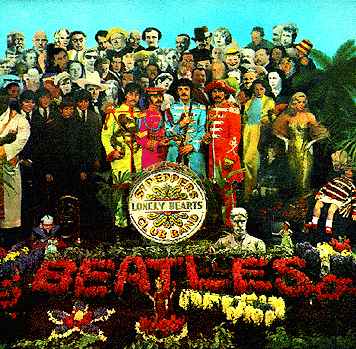 Sgt. Pepper's Facts
Although most of the next two weeks would be taken up by recording the two
songs for their next single, Strawberry Fields and Penny Lane, recording
for Sgt. Pepper's started on December 8, 1966 with take one of When I'm
Sixty-Four. The last track recorded was violins and cellos for Within You
Without You on April 3, 1967, and mixing was completed April 20. Almost as
an afterthought, the sounds for the Sgt. Pepper's ending groove were
recorded the next day.
The original working title of A Day In The Life was "In The Life Of..." A
rare session outside of Abbey Road occurred during the time of the Sgt.
Pepper sessions at Regent Sound Studio in London for part of Fixing A Hole
on February 9, 1967. Also during this period, the long-lost avante-garde
Beatles recording called Carnival of Light was recorded on January 5,
1967.
Sgt. Pepper's Lonely Hearts Club Band was officially released in both mono
and stereo on June 1, 1967, although it was rush released in the UK on May
26. It was actually played on the radio in Britain on the BBC show Where
It's At, the week before on May 20, except for A Day In The Life, which
had been banned by the BBC the day earlier, on the grounds that it could
encourage a permissive attitude towards drugs.
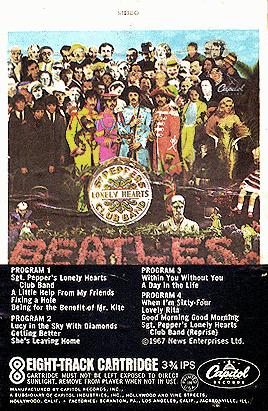
Album Variations
Because of the way 8-Tracks cartridges worked, they had to contain 4
segments of similar length. When they were released on 8-Tracks, most LPs
had to have their song order scrambled so that the songs fit properly on
four programs.
However, when Capitol made the 8-Track of Sgt. Pepper's Lonely Hearts Club
Band, not only did they change the track order, but they actually edited a
song to be longer so that it would fill up one program.
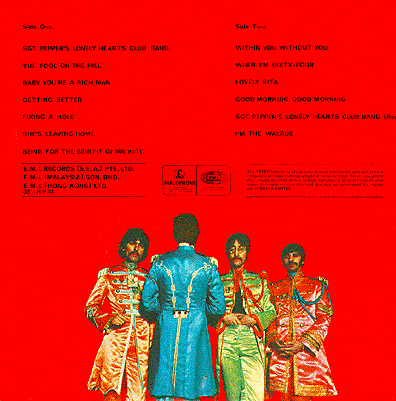
Silly Censorship
In another Sgt. Pepper's related oddity, the official version of the Sgt.
Pepper's Lonely Hearts Club Band LP made by EMI in Australia/Malaysia/Hong
Kong was censored of three songs that apparently could have possibly been
interpreted as being "drug related".
The songs that were removed were With A Little Help From My Friends, Lucy
In The Sky With Diamonds and A Day In The Life. They were replaced on the
album with three songs from the Magical Mystery Tour album; The Fool On
The Hill, Baby You're A Rich Man and I'm The Walrus (sic).
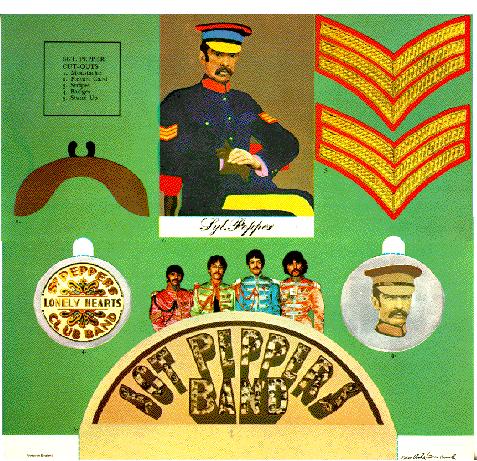
Where have you gone, Sgt. Pepper? The mono and significantly different version of this classic album as ever been issued on CD, though it seems it almost was.
Terry Ott
National Post
As reported recently in the National Post, the Beatles' Sgt. Pepper's Lonely Hearts Club Band is the worst album of all time. According to a poll in British weekly Melody Maker that is, and in direct contradiction to
general opinion. For years, the 1967 LP has been regarded as the summit of serious pop music. Many hard-core Beatles fans were put out in 1997 when Capitol EMI failed to commemorate the 30th anniversary of Sgt. Pepper's original issue. The omission is especially surprising in the light of recent news that a few months late Capitol is bringing out a limited edition 30th anniversary CD package of the less celebrated White Album from 1968.
Fans may be even more perturbed to learn that a unique re-release set of Pepper was all set for publication, but had the plug pulled at the 11th hour. The reasons are as yet unclear and the record company seems surprisingly unwilling to discuss the matter.
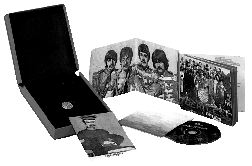
The news report of the damning verdict by Melody Maker pundits reminded me of the project and sent me searching for evidence. An EMI information letter sent two years ago to some journalists, myself among them, confirms that I had not been dreaming. In fact it lists Nov. 25, 1997, as the release date for an elaborate Sgt. Pepper box set: A one-off "for the world" manufacture, available for a limited time only. The package featured a hinged box design containing a remastered disc (bearing the original Parlophone label), a double
wallet, postcard, psychedelic inner sleeve, an enamel badge, and an amended 36-page booklet with "extensive notes."
Most remarkable of all, however, would have been the sound of the disc itself. Four decades after stereophonic recording became the norm; EMI was planning to re-release Sgt. Pepper in mono.
Surprisingly, this is something many Beatles fans have clamored for.
Shortly before the abrupt cancellation of the project, an enthusiastic EMI-Canada representative told me that the remastered one-channel sound was "unbelievable" and evidently so pristine, one "could hear a
chair being slid across the studio floor." Now, he angrily refuses even to discuss the failed release.
So why was so much attention lavished on remastering in an antiquated format, why was the project axed, and why won't the company talk about it?
First, the mono question: As most Beatles fans are aware, George Harrison, producer Sir George Martin, and recording engineer Geoff Emerick have all said that the original album was intended as a monaural experience and, consequently, much more time, care and effort went into the mono mixing than the stereo version. Although established as the standard for classical recording, at the time stereo was considered more of a fad in the area of pop music.
Whether by accident or design, initial printings of the LP sleeve contained the words "This is a mono recording" on both stereo and mono versions. The evidence suggests that the mono Pepper is the definitive Pepper, yet it is currently unavailable, as it has been since EMI switched its production to stereo only, long before the arrival of CD.
According to Mark Lewisohn, author of The Complete Beatles Recording Sessions (1988), 700 hours of studio work went into the making of Sgt. Pepper, yet only around 10 hours were spent mixing it in stereo. In the words of Lewisohn's exhaustive chronicle, "during the production of Sgt. Pepper, the Beatles are said to have taken a hands-on approach with the mono mixing yet left the task of the stereo mixing entirely to others."
Session logs confirm that, in almost every case, the final mono mix
was completed soon after a finished recording was attained, and with all, or most, of the Beatles present.
While most of the differences between the mono and stereo mixes are subtle matters of tone and balance, some are obvious. The most noticeable would be the mono version of She's Leaving Home, which clocks in eight seconds faster than the stereo version, giving the song a less dirge-like quality.
The crossfade between Good Morning, Good Morning and Sgt. Pepper's Lonely Hearts Club Band Reprise has only a four-tap intro with laughter and a short, less resonant guitar lick than the 10-tap crescendo of the stereo version.
There are other noticeable differences in the kaleidoscope sound effects of Being for the Benefit of Mr. Kite, and the cacophony of the ending of A Day in the Life. But it is in the overall ambiance of the mono mix that one can take pleasure in the way that the Beatles themselves wished to hear the album.
It therefore seems fair to ask why a project of this magnitude and significance would suddenly be spiked yet the answers seem buried under a blanket of denials, secrecy and threats.
Shan Kelly, vice-president of strategic marketing for Capitol-EMI Canada, offered little help in placing pieces into the intriguing puzzle. "I don't know much more than you do. We take what comes across
the pond," he said, referring to EMI head office in Britain, which is responsible for all Beatles projects. "I don't know why it was cancelled. I'm being completely candid with you."
Despite the company's "We are pleased to announce" release date and a color photocopy of what looks like a photograph of the complete package, Kelly insisted the photo was a "mock-up" and that not even test CDs had been manufactured. He suggested "for the good of the paper" that the Post contact Mike Heatley, who oversees the Beatles releases world-wide for EMI in England; Heatley did not return several phone calls.
Someone who did was Tim Neely, an author and research director for Goldmine magazine in the United States, who has extensive contacts in the recording industry and has previously been approached by EMI America to work on another Beatles related project.
"Wow! I never heard anything about it," Neely exclaimed. Personally, I think it would be a wonderful thing because the mono Pepper has a better flow."
The album, which producer Martin has called a "tone poem," suffers in the present stereo format in the ears of many Beatles fans, Neely said. He speculated that the box set was axed for political/business reasons.
"I suspect that someone within the Beatles' own management group said no," he explained, referring to the so-called "committee" that presides over every Beatles release. One nay vote scuttles any release, Neely said.
"The record company concocts plans and does things, and if they don't get approval, the thing unravels," ventured Neely, who believes that EMI has not excelled in the marketing or reproducing of the Beatles on CD. Indeed, in some quarters the company has been soundly raked over the coals for its handling of the Beatles catalogue. "Apart from the Anthology series, they just won't do what the fans want," charged Neely.
Perhaps this is what has led EMI to be so defensive. Approached on the subject of the Pepper CD, one EMI marketer was so upset that he barked over the phone: "You want to talk to EMI in the future, you got to pull out of the story."
However, before hanging up, the official did say: "This [CD] may or may not happen in the future. I don't have a crystal ball." So despite the threat of excommunication, this article is offered in a spirit of
encouragement and support for a worthy enterprise. Maybe the EMI executives will reconsider, with a little help from their friends.
 HOME
HOME